
MACHINE LEARNING
Feature importance with random
forest classification
Classifying passenger satisfaction across flight classes and generational segments to uncover which service drivers matter most, and where airlines should focus strategic investment.
Random Forest
Feature Importance
Classification
Python · Tableau
14
Services
+38.84%
In-flight Wi-Fi Importance
+23.03%
Online Boarding Importance
THE BRIEF
Unifying paid social & search campaign results
The team can track and analyse all paid social & search campaign results in order to optimise their upcoming campaigns
Problem
Strict budget limits and "one-size-fits-all" strategic marketing prevent airlines from maximising passenger satisfaction.
Without segment-specific data, it's impossible to prioritise the strategic investments that best address the unique needs of different generations and flight classes.
Objective
Identify the top service drivers by classifying satisfaction across flight classes and generational segments, guiding strategic investment and marketing activities toward what actually moves the needle.
METHOD USED
Random Forest Classification
Feature Importance Model

THE DELIVERABLE
Results Structure
Sections of project
Economy vs business class
Based on Generation (Gen Z, Millenial, Gen X)
Summary of Key Insights
Economy Passengers Service Importance
Top 3 satisfaction driver services across all passengers areIn-flight Wi-Fi, online boarding, ease of booking
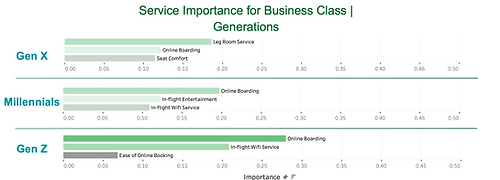
Business Class - A generational divide emerges
Gen X prioritises physical comfort (legroom, seat comfort) while Millennials and Gen Z lean toward digital connectivity (Wi-Fi, entertainment).
Economy Class - Digital Connectivity Leads
In-flight Wi-Fi is the strongest driver, followed by online boarding and ease of booking. Preferences are uniform across generations, allowing a streamlined, universal investment approach.


THE MODEL
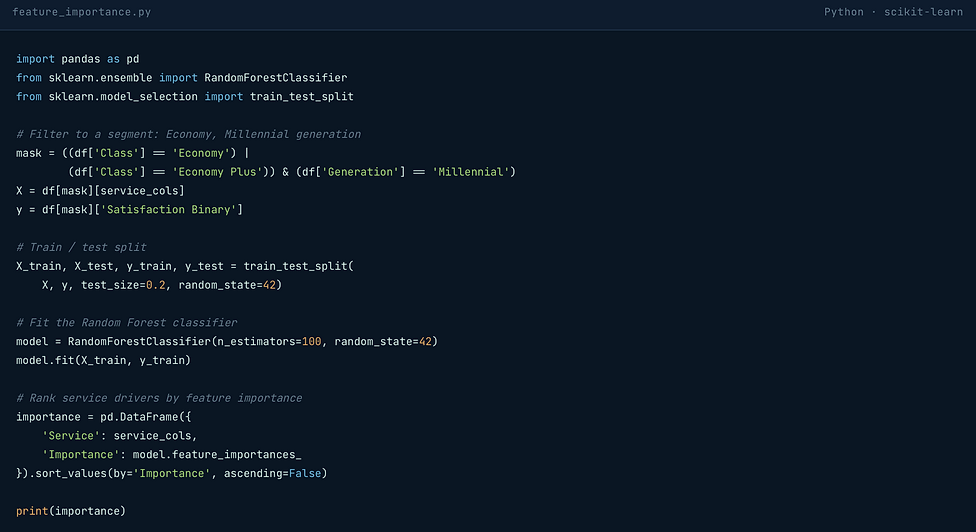
Python behind the importance scores
MORE
Deep Into the Project
The ForestFlight project uses a "wisdom of the crowd" approach to analyse customer feedback. Instead of relying on a single calculation, the system builds hundreds of individual decision models that work together to predict whether a passenger will leave satisfied. By looking at how these models make their choices, we can measure feature importance — essentially a ranking that tells us which specific services (like Wi-Fi or seat comfort) are the most powerful triggers for customer loyalty.
To make these insights actionable, I divided the data into specific groups based on age and travel class. This allowed the system to see patterns a general overview would miss. For example, it revealed that what makes a flight successful for a young professional in Business Class is completely different from what a frequent flyer in Economy values. By pinpointing these specific needs, the project provides a clear roadmap for where the airline should spend its budget to get the best results from its strategic investments and marketing.